
Dungeons 4

Dungeons 4

Not enough ratings
Dungeons 4 Strategy Guide
By dragontamer
Gameplay fundamentals from an RTS perspective. Covers Economy, Micro, Unit Matchups, Resource Management, stages of a typical level.
   
Award
Favorite
Favorited
Unfavorite
Introduction
Dungeons4 is an excellent single-player RTS / Defense game with a rather peculiar sense of humor. However, the new player likely is coming into this game full of confusion with all the options presented to them. I hope this guide can help spread the love of this game!

This guide is not designed for any particular map. Instead, I hope to give enough information for the reader to have enough understanding to come up with reasonable strategies across all maps.

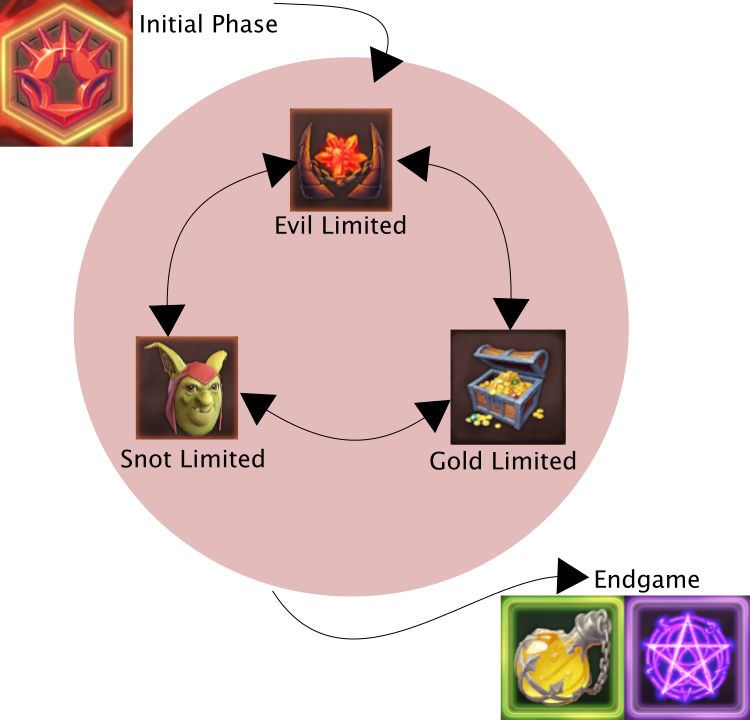
First comes the phases of a typical game. I go over the initial phase, then the endgame. Then the three phases of Evil Limited, Gold Limited, and Snot limited... the three of which take up the bulk of the middle game as you juggle your resources.

Once that is understood, I cover the Units you can buy in this game. Following that, some combinations of units that I've personally found useful. Enemy heroes are talked about next.

The Army provides overall offense-and-defense. Traps are specialized defense-only underground-only structures. I'll finish by covering how Traps can be used to improve defenses.
Strategy Overview
Each Dungeons4 map progresses across 5 phases: Initial Phase, Evil-limited phase, Gold-limited phase, Snot-limited phase, and Endgame.


The "Initial Phase" is when the player spends their initial Evil and Gold on the first army. It must be an army powerful enough to gather Evil (otherwise you get stuck in the Evil Limited Phase). As you gather evil from various objectives with this army, you eventually run out of Gold Veins. You must then dig underground, searching for the new Gold Veins.

Once you've collected enough Evil and Gold, Snots will be the limitation. Trap placement, building placement, and various maintenance (Mana Shrines, Hero Corpse pickup, Prisons, and more) require a Little Snot walking around and dragging items or working machinery to continue. Advancing in "Dungeon" research will hire additional Snots, and Snot research can improve your Snot's movement speeds, their stealth (removing how often they are distracted by enemies), and even allow teleportation across your dungeon.

The game continues to alternate between Evil-limited, Gold-limited, and Snot-limited phases until the player reaches some kind of endgame composition. There's many different endgames to work towards, but I personally suggest for Voodoo Brew 3 + Advanced Potions to take advantage of Horde Speed (+80% attack speed and movement speed), as well as Horde Strength (+120% attack), leading to +296% total DPS. This massive DPS, plus a nice combination of splash-damage units, is often enough to finish the map.

The Prison Question

The biggest strategic question per map is the Prison question. Undead2 100Evil + Undead3 200Evil + Prison1 300 Evil is a substantial 600 Evil investment. And even after all that, you need to wait for enemy heroes (or Dwarves) to attack, be defeated, and then slowly rot in the prison before you collect even 5 Evil back.

Nonetheless, every "Prison" game I've played has thousands-upon-thousands of Evil gathered from the Prison. Inevitably your Prisons "make up" the 600 Evil initial investment and create a profit eventually. But that 600 Evil initial investment could have brought you a substantial way towards like Orc Champions, or unlocked Gnomes/Infernals (300Evil) for substantial splash attack.

The speedrunner will assuredly favor a stronger mobile army and simply try to complete objectives faster (even on extreme difficulty). But a more turtle-oriented defensive player may instead prefer a longer and less-APM heavy game.

In any case, if you build a Prison make it large enough to handle the Dwarf settlements you come across. A single Dwarf Base can have over a hundred Dwarf Heroes defending it, leading to nearly a thousand Evil so long as you have enough Prison space to hold everyone.

The "Win Harder" n00b traps

In the vast majority of games I've played, "Winning Harder" is suboptimal. If you're already winning, there's not much point to winning even harder. Just complete the map and move on.

Still, there is a lot of fun to torturing Heroes in the Torture Chamber until they're obedient. Or spending Evil on Pillars of Strength to reach higher levels. Or maxing out all of the research tree. But just keep it in mind: a "good strategy" is one that turns you from "losing to winning". Not from "winning to winning-more". If you need to be "winning" to start a strategy, the strategy is likely a waste of time to consider.

For example, you could max out all of your army research on Undead (maxing out Graveyard, Banshee, Bone Lords, Vampires, Temple6, and Necromancers). But this requires thousands-and-thousands of Evil and nearly a hundred-thousand gold (especially when we consider fleshing out a 30-man army out of 1500 Bone Lords). To even consider this strategy requires more resources than entire games of Dungeon4!!

If you're "already winning" before the strategy began, then its not so relevant how powerful your army is. Instead, the focus should be on finding more efficient ways to transition between "early game weakness" and "middle game deathball".

In any case: if you find a strategy fun, then yes use the strategy. The point of games is to have fun after all. But always keep in mind the goal. If your goal is to complete a map, then some of these... "fun" features might be more of a distraction rather than "good strategy". There's nothing wrong with that. Just keep it in mind.

A good strategy successfully advanced your position in the game, moving out of a "limited" phase and towards an "endgame" composition of some kind. The easiest way "out" of evil-limited phase is to simply spend less evil. The easiest way "out" of a gold-limited phase is to spend less gold. And the easiest way "out" of a snot-limited phase is simply to have fewer tasks for your snots. Always factor in the major costs (evil, gold, or snot-time) of your various strategies.
Initial Phase and Endgame Phase
Initial Game Phase (Skirmish Maps only)


* Dungeon 1
* Treasury 1
* Little Snots 1
* Dungeon 2
* Workshop 1
* Doors 1
* Vault of Evilness 1

In this "Gold-only" stage of the game, your primary goals are to find the initial gold veins, begin mining them and then optimize your mining of gold. A lot of your APM will be spent slapping little snots for the +Speed bonus. (Or, you can get "Subservient Little Snots" skill-equipment to progress this stage of the game faster). In any case, you cannot buy any Evil-related technology before the Vault of Evilness1. Once you build the vault, a little snot will pickup your initial 300 Evil, and place it into the vault.

In Extremely Difficult mode, your rooms start at 40% efficiency. Adding a Door for +10% efficiency is an effective +25% improvement to your room's resource gathering. Be sure to add doors and other efficiency improvements as much as possible, as its far more important on the high-difficulty modes. Normal Mode likely doesn't need the doors on each room, but you still benefit +11% or so (going 90% to 100% efficiency).

For Campaign Maps, there's a similar phase except you usually have a Vault of Evil1 already researched and already full of 300 Evil. Its difficult to generalize because every map's starting conditions are different.

So what should the first 300 Evil be? See the "Army Compositions" section, but I generally aim for 200 Evil spent on Horde3/Hideout1/Orc2/Naga2/Demon4/Portal1/Succubus1/Undead1/Banshee1. This leaves at least 100 Evil for other purposes. This also sets up an early game army of
6 Orc + 2 Naga + 5 Succubus + 2 Banshee, which should handle the variety of threats you come across in the early game.

Endgame Game Phase


Endgame already? Yes. Why should I talk about things in order? You, the reader, need to know what an Endgame army even looks like so you know what to work towards!!

An Endgame Army is primarily composed of:

1. Voodoo Brew Horde Speed Tier 3 (+80% speed and +80% Attack Speed)
2. Voodoo Brew Horde Strength Tier3 (+120% damage)
3. Mana Shield Tier3 +700 Temporary HP
4. Meteor Shower Tier3: 500 damage + Knockdown Area of Effect where you click
5. Voodoo Brew Healing Tier 3 (+330 HP whenever required)
6. Portal Teleportation (which can be done over any destroyed Hero Building).
7. Over 25+ units with all the above buffs at well over Level7 experience.

Wait, what army units though? Well guess what? It kind of doesn't matter!!

Endgame Army is _primarily_ that +80% Speed / +80% Attack Speed / +120% damage buff. It doesn't matter what you build by this point, any army composition will slaughter any possible foe near instantly. And with the Portal serving as a teleportation device all over the Overworld, you'll find that endgame tends to be cake. It shouldn't take much more than 10 minutes of endgame to clear the whole map.

The _hard_ part of the game is _getting_ to endgame.
Bottlenecked Phases: Evil, Gold and Snot limitations
Evil Limited Game Phase

With our Endgame goals figured out, we return to the early game. You've figured out where to spend your initial 300 Evil (maybe +200 on Army +100 Economy like I do, or maybe some other split). Now what?

Well, you push out. Time to gather more Evil. Even a "Prison" player will need to push out and gather 600 Evil before the prisons can be researched / built. This is why the initial 15 units is so important, you need to build an initial army that you're comfortable clearing objectives with. No spells, no voodoo brew, no nothing.

Maximize the "power" of your army by filling in every single unit slot. Research Horde3, Demons4, and Undead1. All of which are gold-only research. This gets you 18 units + Thalya, more than enough for common early game enemies. But hero parties is only 10 to 20 worth of Evil, you'll need to complete objectives to start escaping the "Evil Limited" portion of this game.

The most universal objective is the destruction of a "Good Being". This is often worth 700 Evil and should jumpstart whatever strategy you're going for. A speedrunner immediately will gun for Voodoo Brew1 (unlocking the important "Horde Speed" potion, albeit only with 30% bonus but that's a huge buff), and maybe spells afterwards. A Prison player will research Prisons and fall back to a more defensive stance (gotta bring the heroes into the dungeon so they can be dragged into the prison after all).

Gold Limited Game Phase

Eventually you collect so much Evil that you run out of Gold and forgot you haven't found the Vein of Diamonds yet. Woopsie.

So you hit the "Load" button and fallback to your last autosave and think deeply about your gold purchases. Evil is suddenly plentiful, but gold is not. The key to surviving this phase is to have an Army powerful enough to handle all of the underworld tasks of expansion. The Veins of Diamonds are out there... somewhere, but possibly behind a huge number of spiders, lavalumps and Dwarves. With any luck, you've gained enough Exp. points from the previous phase to survive. If not, you'll have to think out a strategy for leveling up.

The Defensive / Prison player will look for these enemies, build up some Traps to hold them off, and stage a careful campaign to pick them apart slowly. You should be able to "micro" units back home by picking them up, and dropping your units inside of the Horde Hideout (which should encourage your Orcs to sleep / heal up), or Graveyard (for Undead Units). Demons will passively heal as long as they are not being attacked. With this technique, you should be able to wear down the enemies of the underground and find those Veins of Diamonds (or barring that, at least find the next Gold Veins to mine). This also provides an opportunity for your army to level up. But if you haven't leveled up yet, simply kill Heroes with trap support. (Traps can damage enemies but ignore your army).

Defensive Players might even invest into Arenas and more casually / slowly build up Experience that way. In any case, keep a bit of foresight and be sure to start looking for gold-veins and/or the diamond-veins before you run out of gold!

Snot Limited Game Phase

The "Snot Limited" phase is characterized by having nearly no gold in your Treasury. But when you look, there's tons of Gold Veins. What's going on, where are all the Little Snots and why aren't they mining?

Well congratulations, you've entered the next phase of the game!! Prison / Defensive players will notice this, likely as Beer is researched. You've discovered Beer and are now building out your mass Beer-nons at all your chokepoints. Guess what? 5 Toolboxes per Beernon, and it takes a surprisingly long time to build Toolboxes!! Its also a surprising amount of effort for your Little Snots to drag heroes into the prisons.

Keep an eye on your snots and see what they're doing. They're mostly walking. So here's what to do:

1. Lock some snots inside of a Treasury with Gold Veins. These snots should be enough to generate the gold needed to get out of this phase. Rightclick on a door to "lock" it, now the Snots can't escape.
2. Research Dungeon4 + Workshop3 + Demons2 + Arcanium1. Thiese are all the bits you need to unlock Mana Batteries. Lock a workshop with a little snot inside, and manually grab mana and drop it into the chamber.
3. Use Mana Batteries to free up Little Snots. First free up Mana Battery + Mana Shrines. Then free up Toolbox creators, etc. etc. until you have more Little Snots working. You'll have to repeatedly "renew" the batteries.
4. Look through your research and find +efficiency bonuses. These various +50% bonuses can lead to each snot doing more work.

If you've done all this and still feel like the Snots aren't efficient enough, you might just have a bad dungeon layout. Shorten paths, optimize walks. Put Mana Shrines/Arcaniums close to the Mana Bath + Mana Batteries. Move Workshops/Toolbox production closer to the traps.

If all else fails, save up enough Evil for the big one: Little Snots6: enable Level6+ Snots to teleport to jobs (!!!). This grossly increases the movement of your snots and should bring you out of the "Snot Limited" portion of the game.
Unit Overview
These tables only list Lvl1 stats. Armor values vary dramatically between levels in non-obvious patterns, but Damage and HP tend to go up by roughly 20% per level. By level 6, your units will have roughly double their HP and Attack.

Horde

Cheap units with +Experience bonuses. These units all "permanently die" before a "Horde Laboratory" is built. Bonus damage vs Dwarfs. Requires a "Hideout" to sleep, and "Gobblers" to eat. Eventually wants constant training at Lvl4+ (Arena), and eventually Beer at Lvl6+ from the Brewery. The last level of Horde unit research unlocks the "Champion" units, with exceptionally awesome special abilities.

Horde Units at Lvl1
Gold
Attack
Attack Speed
DPS
Armor
HP
Role
Orc
300G
16
2 seconds (1.5s when raging)
8 (10.6 when raging)
2
380
Early Game All-around Melee, specializing in tanking
Naga
400G
12 Healing
Per Second
12 Healing
1
230
Early Game Horde Healer/Support
Goblin
250G
15x2
2 Seconds
15
1
210
Stealth Melee DPS. Fastest walking speed in game
Gnome
500G
30 Splash
3 Seconds
15 Splash
0
150
Splash Damage Glass Cannon DPS

Special Notes:
* Orc2 opens "Rage" (-HP +armor +Atk Speed). At Orc4 research, self-resurrects every 5 minutes. Orc Champion/Ironhides have extremely high armor, and a special ability to "Draw Aggro" and force enemies to attack the Orc Champion.

* Naga especially combos well with Orcs. +Research on Naga grants +Armor to Orcs, and otherwise heals Horde units. Leveling up improves healing factor. Does NOT heal demons or undead, Horde-only healing. Naga Champion (aka: Shaman) will resurrect units for free once per 5 minutes.

* Goblins "DPS" melee unit. "Stealth" makes it hard for enemies to target them. Creates vulnerability to physical attack (debuffing enemies struck by Goblin attacks). 25% vulnerability default. 50% after Goblin3 upgrades. With upgrades "Orc Rage" bonus grants nearby Goblins +30% damage. By Goblin4 Ignores 75% of enemy armor. Goblin Champions gain a "charging stun" attack and are even faster.

* Gnomes are a Glass Cannon Splash Damage DPS unit with extra bonus damage vs enemy buildings. "Kaboom" upgrade at Gnome2 deals once-per-minute area-of-effect stun at the cost of stunning the Gnome as well. Gnome-o-Bot (Gnome Champions) change their small bomb into a very large flamethrower with huge fire-based area-of-effect damage.

Demons

Always 666 Gold cost. Automatically resurrects (at the cost of ~1 Evil for Lvl1, but ~9Evil for Lvl5 units). Automatically heals if not attacked for 30seconds. Always ranged attack. Exceptionally easy to "micro" by kiting, especially with Gazer support. Bonus damage vs Elves. Requires significant amounts of Gobblers to stay happy. At Lvl5+ requires a Mana Bath to stay happy. At Lvl7+ requires a Torture Room to stay happy. Cheap (Gold-only) Early Game research, but very expensive late-game research.

Demon at Lvl1
Gold
Attack
Attack Speed
DPS
Armor
HP
Role
Imp
666G
4x10 Fire
2.2
18.2
0
200
Early Game Extremely Long-range Glass Cannon DPS unit
Infernal
666G
2x10 Splash Fire Damage
2
10 Splash Damage
2
290
Medium-range Splash-DPS unit
Gazer
666G
2x20 Damage vs 1 unit / Debuff-Splash Slows / Debuff-Splash Fire Vulnerability
3
13
2
230
Medium-range Splash Debuffing unit with okay attack
Succubus
666G
33 Damage / "12-second Charm" once per minute
2.7
12
3
300
Medium-range MIND-CONTROLS ENEMIES!!!!! Exceptionally powerful once-per-minute ability.

Special Notes:

** Gazer --Medium-range support unit. "Splash Movement-Slows" and "Splash Fire Vulnerability". (one enemy gets damaged. All nearby units get "slow" and +25% damage to fire).

* Succubus -- "Charm" will steal enemy units for 12-seconds (cooldown 60-seconds). Excellent all around unit with the most powerful special ability in the game. "Charmed" enemies will fight on behalf of you (and the Succubus) for

Undead

High gold costs. Automatic AND free resurrection at the graveyard. "Blight" will allow Undead to summon 2 minions or 3 minions (after Temple4 research) or 4 minions (after Temple6 research). All Undead move slower than Horde or Demons. Does not need to eat gobblers. Requires a Graveyard to be resurrected. Requires a Temple at Lvl3+ to stay happy and summon minions. Requires a Necrodancicon at Lvl5+.

Undead Units at Lvl1
Gold
Attack
Attack Speed
DPS
Armor
HP
Role
Banshee
1200G
2x10 Splash + Splash 50% Atk. Speed Reduction
2.5 seconds
8 splash
2
280
Early Game Splash Damage unit. Causes -50% attack speed debuff on enemies. Minions cause +Cold vulnerability debuff
Bone Lord
1500G
20
3 seconds
6.6
3
310
Melee "Tank" unit. Minions are ranged and Minions upgrade to ranged-splash damage.
Vampire Queen
1800G
2x10 Single-target Damage + Splash Healing
3 seconds
6.6 damage + Splash Heal
1
250
Ranged Attack+Support unit. Melee Minions
Necromancer
1400G
3x12
3
12
0
240
Ranged DPS unit with Melee minions. Once per 5 minutes can cast "Blight Mist" for significant support (buffs to undead and nerfs to enemies)

Thalya

Your "commander". If killed, little snots will drag her into the Dungeon Heart and then ALL your Little Snots will start praying for her resurrection. This is an extremely disruptive event where your entire dungeon basically stops functioning. Still, if you're confident of your defenses, Thalia is one more body on the battlefield who has passive self-healing. She also has Evil-based skills but... costing Evil is a very steep price to pay indeed. I recommend only using her skills in an emergency or in the final-endgame stages where you have so much Evil it doesn't really matter anymore.
Army Composition
Army Unit Discussion

The purpose of the "Army" is to propel you out of the early game. Or in other words: the ideal early game army uses the fewest resources (ie: Evil and Gold), that most easily achieves the ability to gather more evil and gold. More Evil and Gold is achieved by defeating heroes, hero structures, underground exploration (defeating Lava Lumps and Manavores).

In other words: the ideal early game army is the strongest army you can achieve with the fewest resources. This will always be map-dependent, as different maps have different amounts of Evil and Gold in them. Furthermore, different maps have different amounts of free starting units, as well as different research levels to be achieved.

For most maps however, I've concluded that the Undead have too high gold costs, and very high evil-research costs. Horde3 is gold-only, while Demon4 is gold-only. Meanwhile, Undead need 100 Evil to advance to Undead2. This is somewhat mitigated with the Prison (which converts captured heroes into a steady supply of evil), but Undead2+Undead3+Prison1 costs 600 Evil (!!!), making this a mid-game purchase for most skirmish maps.

Orc, Naga, Imp and Banshee are unique in that they cost gold-only to research, allowing all four to serve as the backbone to your early army.

Army Compositions

6 Orc + 2 Naga + 5 Succubus + 2 Banshee -- My favored initial 15 army units. Orc2, Naga2, Succubus1 and Banshee1 cost a total of only 200 Evil and provide excellent performance in a variety of early game pushes. Note that the 2x Naga are insufficient for in-combat healing, and are more of a slower "out of combat" healing option. If you need faster healing, return to the Hideout inside the dungeon where the Orcs will sleep. Note that Undead1 / Banshee1 are very weak and cannot level up. The primary purpose of Banshee is -Atk. Speed debuff (making most of your units survive longer), as well as a guaranteed "sacrifice" unit. Banshee resurrect for free at the Graveyard, so use them as sacrificial pawns to help your Army escape from difficult situations.

Mass Succubus + 2x Gazer -- Braindead easy in the Overworld, and acceptable performance in the dungeon. With only one unit type to spam, its about as specialized as you can get, and I'd say the Succubus is the only unit in the entire roster that can function by itself. If you have spare Evil, add +2 Gazers to make Kiting in the overworld easier (movement speed debuffs make kiting so much easier, especially with Succubus Charm automatically creating meatshields for your army). Kiting is nearly impossible in the Dungeon however, so its an Overworld focused army composition.

Mass Goblin + 2x Gazer -- Goblins have "Stealth", meaning you rely upon a support unit of some kind to draw fire. Gazers's -speed debuff is ideal for this high-risk strategy, as it makes maneuvering your Goblins easier. This is likely the best speedrunning strategy due to the absurdly high DPS, but it is incredibly micro-intensive. Goblins have somewhat poor performance in the dungeon due to their inability to micro, but as melee units you'll likely find doors and corners where Goblins do well even vs ranged opponents.

Mass Imps + 2x Gazer -- Like the "Goblin DPS Strategy" but even sharper. Imps already have the best DPS in the game, but 2x Gazers helps spread slow and fire-vulnerability around (25% or 50% more damage depending on upgrades). Due to their incredible range and DPS, mass Imps is one of the easiest to control groups in the overworld, especially vs the Boss Monsters. If you have a substantial Imp army, be sure to build long straight corridors. Imps cannot shot "around" corners underground, and they have very long range. Give your Imps enough space to shine if you want them to work well underground.

Banshee + Bone Lord + Vampire Queen + Necromancer -- Its a bit of a "win harder" move to go with a large undead army, but you cannot deny that 4x minions per unit (Temple6) and the incredible synergy available from this obvious play. Like Volton, every piece of this puzzle is required, as no unit functions well by itself. There's a few campaign maps where this is feasible however: the combo is just too expensive to pull off often at all.

Orc + Goblin + Naga + Gnome -- Too expensive (too much Evil cost) in my experience. At 100 Evil to unlock Goblins and 300 Evil to unlock Gnomes, I've generally felt it more beneficial to push for Hideout / Orc Champion / Naga Champion instead. Goblins and Gnomes are too fragile and weak before their "Champion" forms. If you need DPS, opt for Imps or Succubus instead (and because Imps/Succubus self-heal when out-of-combat, you don't have to run as many low-damage Nagas).

Mass Splash-Damage -- As enemy hero groups grow larger and larger, splash-damage just scales insanely into the endgame. Your mass-splash damage options are Gnomes (or really, Gnome-o-bots Champion form), Infernals, or Banshees. Gnome-o-bots have so much DPS its clearly the best endgame option, but Horde6 + Gnome5 research is well over a thousand-evil of investment. Infernals are cheaper Evil-wise early game, and offer passable endgame performance. Infernals also have great synergy with Gazers (which should be present in any "Kiting" army), and Infernals have enough HP and Armor that they have passable dungeon performance. Banshee deserves a mention because they do not require Evil to begin to mass out, but without Vampire Queens Healing or Necromancers (Blight Myst), Banshees will be worn out and forced to retreat too often. Undead/Banshee are also slower in general, and endgame is mostly a movement game.
Micro: spending clicks to improve your army's performance
In RTS genre, units move suboptimally on purpose to give the player an opportunity to "micro" units. By focusing on the small positioning details that occur in a battle, the player can "spend their focus" on a battle and improve the performance of their units.

In the overworld, traditional RTS micro is possible as you have both "move" (right-click) and "attack move" (right-click AND hold). Furthermore, boss monsters (such as Unicorns) clearly advertise their attacks ahead of time, giving the player time to reposition units outside of the attack area.

Remember: Micro is NOT free. All forms of "Micro" cost the player's most precious resource: the player's attention. Every second spent micro-ing units is another second you are late on building dungeon rooms, research, or other such tasks that benefit your dungeon for the next hour. Only "micro" if you truly have nothing better to do.

Underworld

The underworld "punishes" APM. Every time you "select" a unit in the underworld, the Hand of Evil picks them up and then stuns the unit as you throw them back to the ground. A Starcraft player may think this kills micro all together, but not quite.

Kiting is still possible in the Underworld, it just requires much longer range units (see well upgraded Imps). You can attack, and as the enemies draw close you can pickup and find a new area. With good practice, you can attack "behind" the hero groups, and force the heroes to run backwards (!!!), giving you more time for snots to prepare traps or other units to heal up. Long straight hallways are the best kind of design for this kind of manual kiting.

You can obtain an "attack-move" like order in the underworld by using the "Flag" feature of the Guard Room. All Guard Room units will "attack move" into the location of the flag constantly. If you ring the bell, it will also call all other units in the underground to move towards the location of the flag.

You can "slap" enemies in the underworld to "focus fire" your units. Right-clicking frontal enemies will help make your splash damage units attack a whole group. Or maybe you want to prioritize high-damage enemies like Wizards or Dwarf Pyros. Or maybe the weak Priestess who heals at an average of ~100hp-per-second (!!!!) probably should be targetted first in almost all combat.....

All in all, your underworld opportunities of "micro" are limited. But make the best of it, you still can do "something" to improve your units behavior. Just not as much in the overworld.

Note: Picking up units "instantly" removes them from combat, allowing the perfect player to theoretically always save their units before they die. If only you had enough attention, dexterity, and clicking-speed to do this consistently.....

Tanking

"Tanking" refers to the video game strategy of choosing which units receive damage. In general, you want to place high-hp and high-armor units (such as Orcs, Succubus, or Bone Lords) in a position to take more damage, while low-hp and low-armor units (such as Gnomes or Imps) in a position to avoid damage.

By carefully managing the HP across your army, you can minimize permanent deaths (especially as Orcs can self-resurrect at Orc4 research), and minimize resource expenditure. (ex: Undead units resurrect for free).

Tanking in the underworld is near impossible due to the "stun" applied to your units per click. However, since you can remove units from combat and have them heal (by dropping them in the Hideout, Graveyard), you can effectively save units and rescue them out of sticky combat situations.

Kiting

While Tanking helps your group live longer by spreading damage around, Kiting helps your units live longer by simply not taking damage at all !

Kiting is the strategy where a fast group of units performs ranged attacks, but runs away before the opponents can deal damage back. Kiting is exceptionally powerful with "Gazers", which provide -25% speed debuffs to enemies. As well as Voodoo Brew Horde Speed, which can provide anywhere between 30% to 80% bonus to movement speed (depending on Voodoo Brew upgrade level).

Imps are ideal for kiting, as they have the highest DPS of the ranged units in the game... as well as the longest range, and also have Fire Damage that combos with the Gazer's slow+fire vulnerability debuffs. Imp + Gazer is truly a frightful combination when the player's attention is fully focused on kiting.

Focus Fire

In the underground, a "slap" will force your army to focus-fire one enemy unit down during combat. When used intelligently, this can grossly improve the fighting potential of your units. In general, you want to focus-fire and kill enemy Priestesses, Wizards, Dwarf Pyros, and Dwarf Brewmasters.

Priestesses always have huge healing and provide +armor bonuses to their friends. KO them first and you'll find battles are far easier. Brewmasters provide splash healing AND splash damage, and are also a very high priority target.

Wizards, Dwarf Pyros, are high DPS enemies and/or splash damage enemies.

Stone Guards on the other hand are low-DPS high-armor high-HP units. They do so little damage to your units that you really should focus fire on OTHER enemies in most cases.

Note: Focus Fire doesn't necessarily make your units better. With bad control, you'll do worse than the default actions.

Hands off

Far too often, "micro" is counterproductive. I have a preference for Orc + Naga + Succubus early game because there's very little micro to be had with this army composition.

It is perhaps more important to know how to play "hands off", to command your units to do something and then LOOK AWAY AND FOCUS ON SOMETHING ELSE. The key is to predict battles. If your units are going to win with micro or without micro... its more important to "spend" your attention on other tasks, rather than watching a fight play out that you already know the outcome to.

If your units are likely going to lose, simply click a retreat-move command (and maybe spend some Voodoo Brew for +Speed bonus to make the retreat easier to accomplish). Then look away, your units are now faster than the opponent so there's no point watching them run away, you know they'll get away.

Imp+Gazer and Goblin + Gazer army compositions require significant amounts of focus to perform well. For some players, that's well worth the tradeoff. For other players, its not. I do recommend trying different styles of unit composition and combat, so that you can explore and figure out how you have the most fun.
Heroes Overview
There are far too many hero types to note. So I'll list off their general specs and how various units can be used to counter them.

* Normal Heroes -- Early game. Mostly around 500HP though Stone Guards reach into 1000HP.
* Elite Heroes (Gold) -- Midgame. Mostly around 1500HP though Stone Guards can reach 4000HP.
* Legendary Heroes (White) -- Endgame. 2000HP and 90% damage mitigation from either Physical Attacks or Magic Attacks, and 50% damage reduction to their allies. And other special abilities on top of that. Legendary heroes lose their vulnerability to Horde/Demons/Undead. Truly a ferocious endgame foe. In "Extreme" difficulty, the race is against the spawn of Legendary Heroes, you must be in an advanced enough state to deal with these heroes before they spawn, otherwise the game is easily lost.

There's too many hero types to list. But here's some of the important ones to watch out for:

* Priestess -- Human. Heals allies like 500HP even at Tier1 / Normal heroes. These are almost always a high-priority kill target, otherwise enemies just heal off the damage. Also provides +Armor bonuses.
* Veteran -- Human with high armor and high single-attack damage. You should be able to "burst" them down, but if you see huge 100+ damage hits wrecking some of your units, there's probably an Elite-Veteran or Legendary-Veteran you need to take care of.
* Wizard -- Human. Glassy long-range splash-damage. Very easy to kill but pay attention and prioritize them.
* Pyro -- This Dwarf unit deals significant amounts of splash damage. Keep an eye out for them, especially if you thought your Orcs were tanking. These guys will kill your Gnomes/Goblins because of all the splash damage.
* Brewmaster -- Another troublesome Dwarf unit: splash damage + splash healing for its allies.
* Stone Guards -- Massive amounts of HP at all respective tiers. Low priority target, try to kill everyone else first. Legendary Stone Guards redirect damage directed to their allies, allowing them to form a "tanking" strategy vs the player.
* Archers -- Elf with 25% slow, so your units can't run away as easily. You can counter with slow of your own (ex: Gazers).

A combination of Magic Damage and Physical Damage is the key to killing Legendary-tier parties. As such, it seems inefficient to win on "Horde Only" or "Demon Only" armies. You'll want some physical damage (ie: Gnome-o-bots), and some magical damage (Succubus) to help deal with the wide variety of 90% resistance Legendary threats in the endgame.

Notice that the most troublesome units are Dwarves, and that Horde units have bonus damage vs Dwarves. Large masses of +Splash attack Dwarves are far more powerful than other groups that show up.
Traps
Traps have one of the most important features in all of Dungeons4: they do not cost army population at all! Once your army is maxed out in size, then it becomes important to place Traps intelligently to defend your homefront. Yes, your army can likely crush any hero party that comes around, but its a huge waste of time to run back and forth between the dungeon and the overworld. (Even if you use Portal Magic to do so, its unnecessary mana expenditure). However, Traps have significant gold and toolbox costs. And "Complex Traps" will also cost other resources (gobblers for Gobblenons, and Beer for Beernons, Little Snots for Wheels of Death, and significant amounts of gold for the Epic Treasure Chest).

Nonetheless, there's only three phases of the midgame: Evil Limited, Gold Limited, and finally Snot Limited. In the Evil Limited phase, your snots are idle, no work to do... and Gold is Plentiful. If you have nothing else to spend your Gold + Little Snot worktime on, why not build out lots of traps?

In the Gold Limited phase, it should be noted that the 2000hp Stronghold Door is your most gold-effective HP blocker in the game. No other unit comes close to the price of 500G for 2000HP. As long as the door remains standing, it will even self-heal on its own. Finally, with Door4, even if they are destroyed they come back at no cost (and Door4 grants self-regeneration even during combat, permanently locking out many enemies who fail to outdamage its regeneration + armor)

Furthermore, Beer-nons only cost 500G, cheaper than most units in this game despite doing large area-of-effect damage (especially with the Gobbler-non Fire-vulnerability debuff and Slime-ball Gobbler-debuff).

Your chief downside is that traps cannot move. You must deeply consider their placement lest all your effort goes to waste. Army should be prioritized, but between army caps... cheap evil/gold costs for traps... it just makes sense to integrate at least some traps into your gameplay.

Without further ado, lets go over some trap patterns I've found useful.


We should start with the simplest Trap setup.

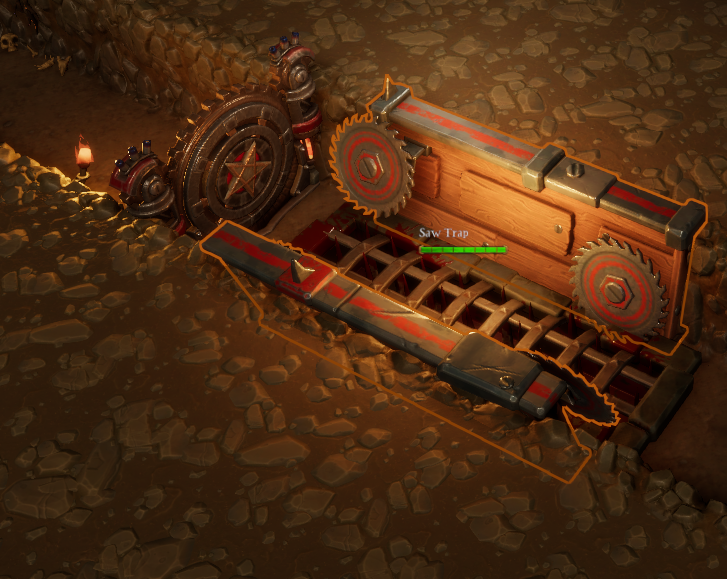
Saw Trap + Spike Trap provides 30 seconds of 23 DPS at Tier1. The Spike Trap never needs supplies, but Saw Trap requires new Supplies every 5 activations.

At Tier2, Saw Trap + Spike Trap provides 45 seconds of 47 DPS. The Saw Trap only requires new Supplies every 10 activations.

At Tier3, Saw Trap + Spike Trap provides 83 DPS. the Saw Trap never needs new supplies ever again.

Even at Tier 3, this chokepoint is unable to KO enemies consistently. Nonetheless, its very cheap (2300G + 9 Supplies) per setup.

It should be noted that Tier3 Doors are noticeably slower than Tier1 Wooden Doors. Only use Stronghold Doors where defense is likely, otherwise you slow down your Little Snots tasks as they sloooooowwwwwly wait for these doors to open.

This design works, but has issues vs ranged units and Priestesses. Ranged units pummel the door from outside the range of the traps, while Priestesses can heal the melee units inside of the spike-trap+saw trap. See the next design for how to deal with that....


The simple early game Door+Saw+Spikes can be improved dramatically with Beernons, Gobblernons, and Slime Balls.

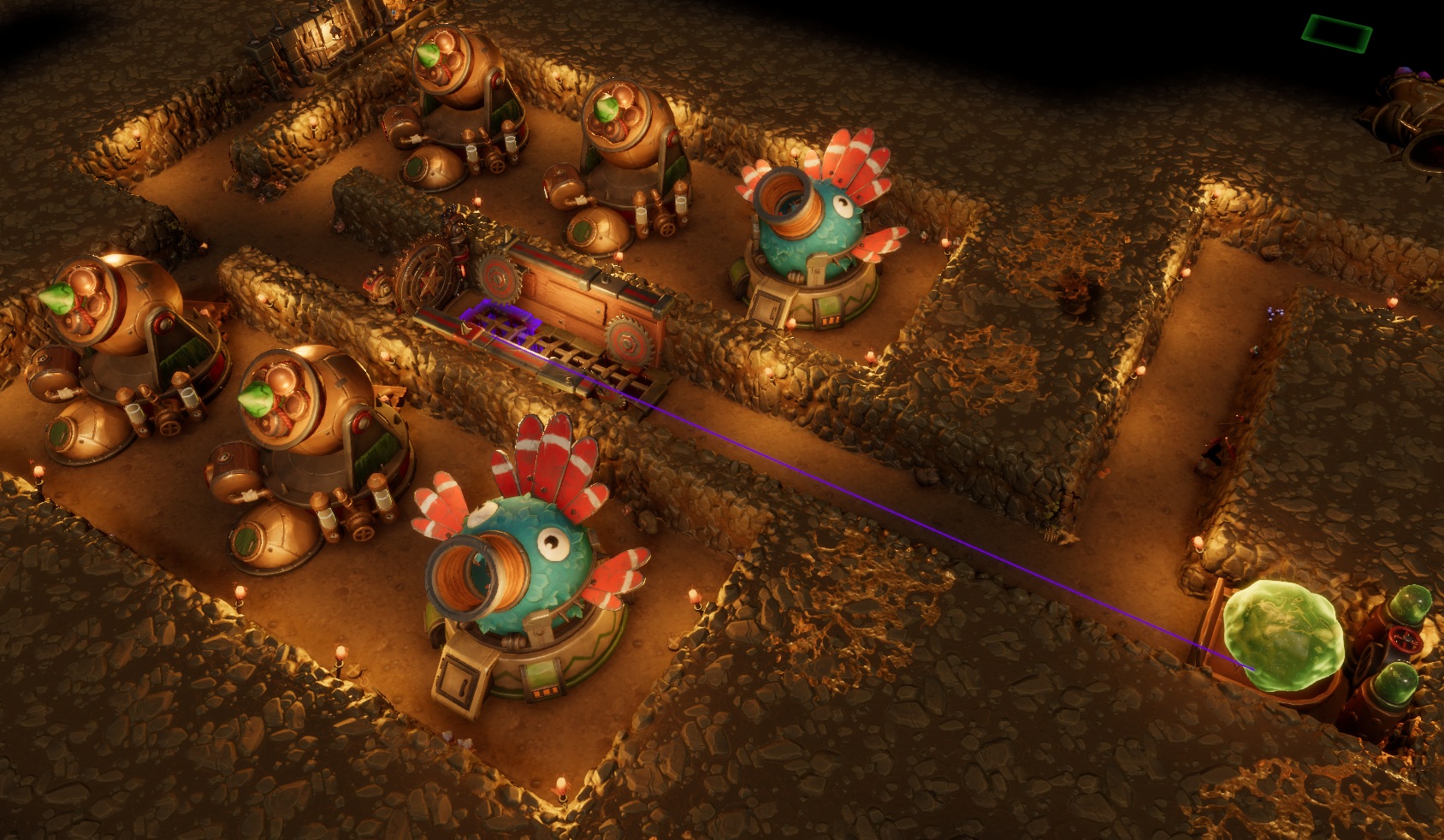
For additional 3500G + 39 Supplies + 8 Beer + 8 Gobblers (on top of the 2300G + 9 supplies original Door+Saw+Spikes), you can add 250 damage of Beernon mass-splash Fire-damage + Knockdown per cannon shot even at Tier1.

1. Beer-nons by default deal 100 fire splash damage, splash fire damage-over-time and knockdown. Repeatedly hammering groups of units with the Beer-non can make your 2000HP stronghold doors last far longer.
2. Gobbler-nons deals +50% fire vulnerability.
3. Slime Balls improve Gobbler-nons by +100%

All of these bonuses and damage improves with research. But even at ComplexTraps1 (which costs no evil at all), the Slime Ball / Gobbler-non / Beer-non combo increases damage to 250 splash damage + Damage over Time + knockdown. With ~4 Beer-cannons attacking a choke point with all the debuffs applied, even a ComplexTraps1 setup should be able to deal with the ~1500HP Elite units and only struggle with Legendary-tier units. It should be noted that Beer-nons and Gobbler-nons shoot over dungeon walls, leading to incredible amounts of flexibility and "Tower Defense" style layouts.

Notice that the slime ball is "pushing enemies in". Also notice where I've placed the trigger, next to the door. This is necessary for grouping together those annoying ranged units (Priestess, Wizard, Archers and Marksmen) all together so that the Beernon's AoE Splash damage hits everyone. By setting the trap so late, it ensures there's enough time for the ranged-units to all get in front of the slime-ball trap before it triggers.

That's all folks

Wait, what about pushers? Threshers? Lava? Okay yes, there's other setups too. Gosh. Some work but lets go over what does work and doesn't work.

1. The 500G per Epic Treasure Chest explosion is too costly and not nearly enough damage. Even if you combine the explosive fire damage with Slime Ball + Gobbler-non, Epic Treasure Chests should be seen as a "last resort" explosion rather than a typical DPS damage dealer. I prefer to not use them at all.

2. The "Little Snot" requirement on the Hamster Wheel of Death is too costly in the middle game IMO. The midgame is full of Little Snot usage, and losing Little Snots to power Hamster Wheels of Death just isn't worth the meager damage they provide.

3. Complex Traps always need more supplies, beer, and gobblers to continue. This does require Little Snots to run supplies/beer/gobblers to your cannon arrays, but you can mitigate these effects by building Toolboxes or Gobblers nearby (so the Little Snots don't have to walk as far).

4. Floor Traps never need resupplying and can therefore be spammed.

5. Simple Traps require resupplies every 3 attacks at Lvl1. Every 10 attacks at Lvl2, and never need resupplying at Tier3.

6. Wooden Doors are fastest for Little Snots (or other people in your dungeon) to move around. Stronghold Tier3 Doors are the slowest. Iron Tier2 Doors are somewhere in between. Only use Tier2 or Tier3 doors where defenses are necessary, otherwise you'll find that your units will be spending surprising amounts of time opening-and-closing doors. Wooden Doors remain one of the best doors even into the lategame due to their speed of opening/closing. Tier4 doors will self-repair themselves even when destroyed, meaning you no longer have to spend 500G + 3 Supplies repairing Stronghold Doors. Stronghold Doors, despite their costs, are likely a better investment as soon as they are available. Wooden Doors break down quickly (only 500HP), which then requires 250Gold and a Toolbox to rebuild. A Tier3 Stronghold Door has 2000HP and likely can survive more punishment. If it survives, then Doors will self-repair without any cost in Gold or Toolboxes (even before Tier4. Tier4 just allows them to self repair in combat and even when the door dies).

7. If you are struggling with Legendary-tier heroes, try fighting close to your traps. 100 Splash Damage from your Gobbler-nons and 100-500 splash Damage + Knockback from your Beer-nons really improves your army's capabilities.